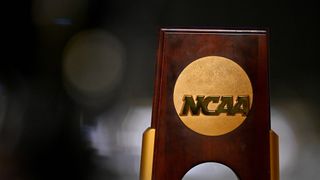
Apr 19, 2025; Fort Worth, TX, USA; A view of the NCAA logo and trophy before the 2025 Women's National Gymnastics Championship at Dickies Arena. Mandatory Credit: Jerome Miron-Imagn Images

House v. NCAA settlement approved, paving way for revenue sharing

The settlement of House v. NCAA was given final approval by Judge Claudia Wilken on Friday night, allowing colleges to directly pay players via revenue sharing for the first time.

Wilken’s stamp of approval was long expected, and the settlement marks the end of the NCAA’s previous model of amateurism, in which athletes were not allowed to earn money while in school.

Beginning July 1, schools can share up to $20.5 million of their revenues with their athletes. That cap will increase by at least four percent each year for the next 10 years.

The settlement also allots $2.8 billion in back payments for athletes who missed out on earning opportunities while in school between 2016 and 2024.

The ruling settles three separate antitrust suits brought against the NCAA, most notably by ex-Arizona State swimmer Grant House and women’s college basketball player Sedona Prince.

It also builds on the previous legal case that opened the door for athletes to earn money in the first place. The Supreme Court case of NCAA v. Alston, decided nearly four years ago, removed limitations on college athletes making money on their own names, images and likenesses.

So-called NIL deals quickly became cover for boosters to raise money to give star players salaries. NIL does not disappear under the House v. NCAA settlement, although soon an NIL clearinghouse operated by Deloitte will be introduced to scrutinize athletes’ deals and determine whether they exceed their fair market value.

–Field Level Media

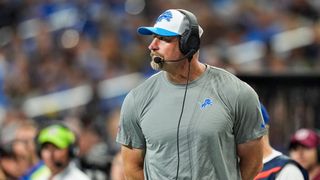
Detroit Lions head coach Dan Campbell watches a play against Pittsburgh Steelers during the first half of a preseason game at Ford Field in Detroit on Saturday, August 24, 2024.

Report: Lions coach Dan Campbell sells home over security fears

Detroit Lions coach Dan Campbell and his family have moved to a new home in the metro area, forced to list their former house for sale out of security fears.

Crain’s Detroit Business reported the Campbells’ address got out online, leading to pranks and harassment on multiple occasions. After the Lions lost to the San Francisco 49ers in the NFC title game in January, the family filed a police report over harassment, Fox 2 Detroit reported.

The publication said Campbell and his wife, Holly, bought what it described as a 7,800-square-foot Cape Cod-style “mansion” in Oakland County, Mich., in 2021.

“The home is beautiful,” Campbell told Crain’s. “It’s just that people figured out where we lived when we lost.”

While Campbell gave no information about the family’s new home, the old one was listed on Zillow at $4.5 million on Tuesday and was under contract the same day. Per Zillow information, the five-bedroom, seven-plus bathroom home set on 1.72 acres sold for $3.5 million in March 2021.

Campbell’s Lions were 3-13-1 in his first season in 2021 but have gone 22-14 since.

–Field Level Media

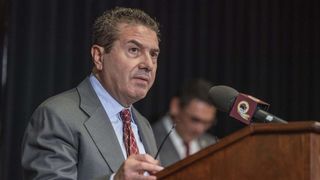
Jan 2, 2020; Ashburn, VA, USA; Washington Commanders owner Daniel Snyder speaks during the introductory press conference for head coach Ron Rivera at Inova Sports Performance Center. Mandatory Credit: Brad Mills-USA TODAY Sports

House Committee: Daniel Snyder allowed toxic culture, NFL aided in cover-up

Washington Commanders owner Daniel Snyder suppressed evidence that he and team executives sexually harassed women who worked at the team for over two decades, the U.S. House of Representatives Committee on Oversight and Reform said Thursday in its final report after a nearly 14-month investigation.

In a 79-page report released Thursday, the Committee detailed the decades-long toxic workplace culture of the Washington franchise, the NFL’s response to the conduct and the league’s burial of a 2020-21 probe of the Commanders’ workplace led by attorney Beth Wilkinson.

The Committee’s report also notes the NFL was complicit in Snyder’s efforts against cooperating with the inquiry and was aware of the interference with the Wilkinson Investigation but failed to take action. It said the league’s mishandling of the investigation reflected “a broader pattern of failing to take workplace misconduct seriously.”

The report also detailed that Snyder “permitted and participated” in the franchise’s toxic work culture and went to great lengths to obstruct the Committee’s inquiry.

“Mr. Snyder was invited to testify at a public hearing but refused to appear and then sought to avoid service of a subpoena while abroad with his yacht,” per the report. “Mr. Snyder ultimately sat for a private deposition but failed to provide full and complete testimony. Over the course of the deposition, he claimed more than 100 times that he could not recall the answers to the Committee’s questions, including basic inquiries about his role as Team owner and multiple allegations of misconduct. Mr. Snyder also gave misleading testimony about his efforts to interfere with the Wilkinson Investigation.”

The report also chastised the NFL for failing to prevent Snyder from interfering with its investigation and for failing to address his conduct.

“The NFL chose to bury Ms. Wilkinson’s findings and whitewash the misconduct it uncovered,” the committee’s report said. “Rather than seek real accountability, the NFL aligned its legal interests with Mr. Snyder’s, failed to curtail his abusive tactics, and buried the investigation’s findings.”

An NFL spokesman told ESPN that the league had not seen the report and would not comment.

–Field Level Media