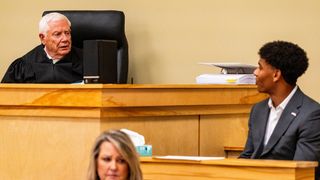
Lafayette County Chancery Court Judge Robert Whitwell, left, questions Ole Miss quarterback Trinidad Chambliss, right, during the hearing in his lawsuit against the NCAA at Calhoun County Courthouse in Pittsboro, Miss., on Thursday, Feb. 12, 2026. Chambliss is looking for a temporary injunction and a permanent injunction against the NCAA for one more year of eligibility.

Ole Miss QB Trinidad Chambliss granted injunction by Mississippi judge

A judge in Pittsboro, Miss., ruled Thursday that Ole Miss quarterback Trinidad Chambliss deserved a medical redshirt in 2022 at Ferris State and therefore merits one more year of college football eligibility.

Chambliss, who finished eighth in the 2025 Heisman Trophy race while leading the Rebels to the College Football Playoff semifinals, had his appeal to play in 2026 denied by the NCAA on Jan. 9.

That led Chambliss’ lawyers to file for the injunction granted Thursday by Judge Robert Whitwell in Lafayette County Chancery Court. The University of Mississippi is located in Oxford, the county seat for Lafayette.

Whitwell spoke for more than an hour before declaring Chambliss would receive the injunction. He declared the NCAA showed “bad faith” when denying Chambliss’ appeal by ignoring evidence brought forth by Ferris State doctors.

Chambliss spent his first four college years at Ferris State. He redshirted as a freshman in 2021, appeared in just two games due to injury in 2022 (triggering the belief he merited a medical redshirt) and threw just 33 passes as a backup in 2023 before directing Ferris State to the Div. II national championship in 2024.

The Grand Rapids, Mich., native transferred to Ole Miss in 2025 and became the team’s quarterback in Week 3 after starter Austin Simmons suffered an injury. Chambliss wound up leading the Rebels to a 13-2 season that ended with a 31-27 Fiesta Bowl loss to Miami on Jan. 8.

Chambliss completed 66.1% of his passes for 3,937 yards, 22 touchdowns and just three interceptions. He also rushed for 527 yards and eight scores.

He signed a lucrative NIL deal to return to Ole Miss, but that was placed in jeopardy when his waiver appeal was denied.

The NCAA can appeal Thursday’s decision, so Chambliss isn’t guaranteed to be in uniform when Ole Miss opens the 2026 season against Louisville on either Sept. 5 or 6 in Nashville.

The NCAA issued a statement shortly after the injunction was granted:

“This decision in a state court illustrates the impossible situation created by differing court decisions that serve to undermine rules agreed to by the same NCAA members who later challenge them in court. We will continue to defend the NCAA’s eligibility rules against repeated attempts to rob future generations of the opportunity to compete in college and experience the life-changing opportunities only college sports can create. The NCAA and its member schools are making changes to deliver more benefits to student-athletes, but the patchwork of state laws and inconsistent, conflicting court decisions make partnering with Congress essential to provide stability for current and future college athletes.”

–Field Level Media

Duke’s Darian Mensah requests expedited hearing on transfer

Duke quarterback Darian Mensah turned to a hurry-up offense, requesting an expedited hearing on Friday as he seeks a court ruling on his transfer plans.

The Durham (North Carolina) Superior Court ruled earlier this week that Mensah is allowed to enter the transfer portal but cannot enroll at another school until a judge rules on Duke’s request for an injunction that would stop him from leaving.

The preliminary injunction hearing is scheduled for Feb. 2 with Judge Ed Wilson, but Mensah’s attorneys contend that will be too late.

“Deadlines at other collegiate institutions who have indicated to me their interest in my enrollment will expire on Friday, Jan. 23, 2026,” read an affidavit filed by Mensah on Friday.

Duke insists that Mensah still is bound by his multiyear NIL contract with the university.

“Mr. Mensah has an existing contract with Duke which the university intends to honor, and we expect he will do the same,” Duke’s athletics department said in a statement Wednesday. “The court-ordered temporary restraining order (TRO) issued yesterday ensures he does not violate his contract. The university is committed to supporting all of our student-athletes, while expecting each of them to abide by their contractual obligations.”

Mensah previously had stated on Dec. 19 that he was returning for a second season with the Blue Devils instead of entering the draft after reportedly signing a two-year, $8 million deal ahead of the 2025 season.

After spending his freshman season at Tulane, Mensah was the second-team All-ACC quarterback in his first season with Duke, throwing for a conference-leading 3,973 yards and 34 touchdowns with just six interceptions in 2025. He led the Blue Devils (9-5) to their first outright Atlantic Coast Conference championship since 1962.

Mensah reportedly wants to transfer within the Atlantic Coast Conference to Miami, potentially replacing outgoing starter Carson Beck.

–Field Level Media

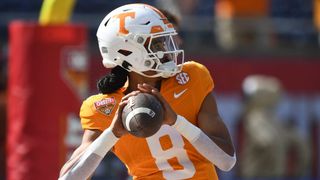
Tennessee quarterback Nico Iamaleava (8) warming up for the Citrus Bowl NCAA College football game on Monday, January 1, 2024 in Orlando, Fla.

NCAA’s NIL rules frozen as judge grants injunction

The NCAA cannot punish students or athletics program boosters for name, image and likeness recruiting inducements — at least for now — as a result of a federal judge’s preliminary injunction on Friday afternoon.

The injunction is not a final ruling in the case of Tennessee and Virginia v. NCAA, but the NCAA is in danger of fully losing its ability to enforce its NIL rules, which have been called into question by the attorneys general of both states.

“The NCAA’s prohibition likely violates federal antitrust law and harms student-athletes,” U.S. District Judge Clifton Corker wrote Friday.

Although the related court case is still active, Corker’s injunction means that athletes are free to negotiate NIL-related compensation before they enroll at a school. Though the judge is from the Eastern Tennessee District, his decision applies to the entire country.

The case stems from the NCAA’s decision in January to launch an investigation into the Tennessee football program over alleged recruiting violations. It centered on Nico Iamaleava, a five-star quarterback recruit coming out of high school, signing a deal with Tennessee’s primary NIL collective, Spyre Sports Group, reportedly worth $8 million.

Tennessee chancellor Donde Plowman addressed a biting letter to NCAA president Charlie Baker last month, claiming the NCAA is not doing its part to establish clear rules for student-athletes, their families or universities.

“Instead, two and a half years of vague and contradictory NCAA memos, emails and ‘guidance’ about name, image and likeness (NIL) has created extraordinary chaos that student-athletes and institutions are struggling to navigate. In short, the NCAA is failing,” Plowman wrote in part.

The AGs of Tennessee and Virginia filed their antitrust lawsuit against the NCAA the next day.

“Without the give and take of a free market, student-athletes simply have no knowledge of their true NIL value,” Corker wrote Friday. “It is this suppression of negotiating leverage and the consequential lack of knowledge that harms student-athletes.”

Tennessee attorney general Jonathan Skrmetti said in a statement to news outlets Friday that his state would continue pursuing its litigation “to ensure the NCAA’s monopoly cannot continue to harm Tennessee student-athletes.

“The NCAA is not above the law, and the law is on our side.”

NCAA student-athletes have been allowed to profit off their names, images and likenesses since the Supreme Court ruled in their favor in NCAA v. Alston in the summer of 2021.

–Field Level Media